
How Much Mulch Do I Need? Cubic Feet Explained
By Jane Robert, Content SpecialistReviewed by the Measurement & Standards Team
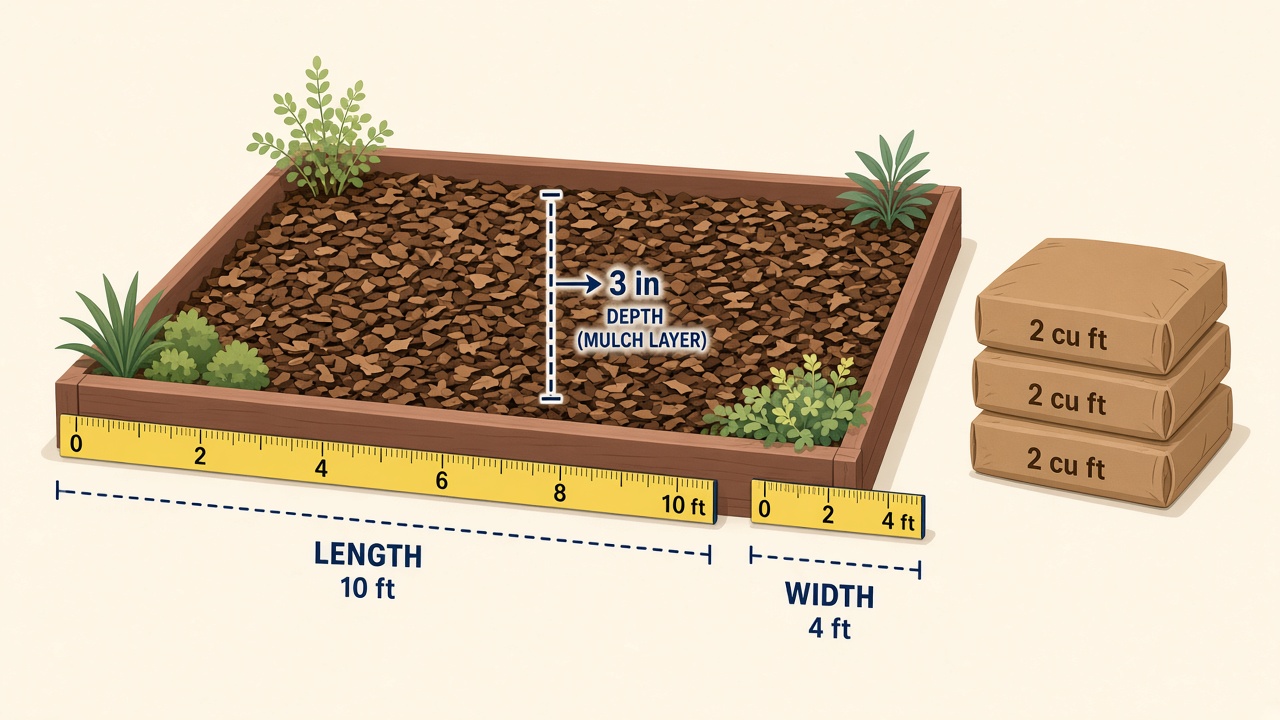
How Much Mulch Do I Need?
To calculate how much mulch you need, multiply the bed area in square feet by the mulch depth in feet to get the cubic feet required. A 120-square-foot bed at 3 inches deep needs 120 × 0.25 = 30 cubic feet of mulch. Divide that total by 27 for cubic yards, or by the bag size for the number of bags.
Mulch is measured by volume, so the amount depends on both the area you are covering and how deep you spread it. The Cubic Feet Calculator works out the volume from your measurements, and this guide turns that volume into cubic yards and bags so you order the right quantity.
The Mulch Formula
The mulch formula is Mulch (cubic feet) = Area (sq ft) × Depth (ft). The area is the size of the bed, and the depth is how thick you want the mulch layer. The depth is converted from inches to feet by dividing by 12, so 3 inches becomes 0.25 feet and 2 inches becomes 0.167 feet.
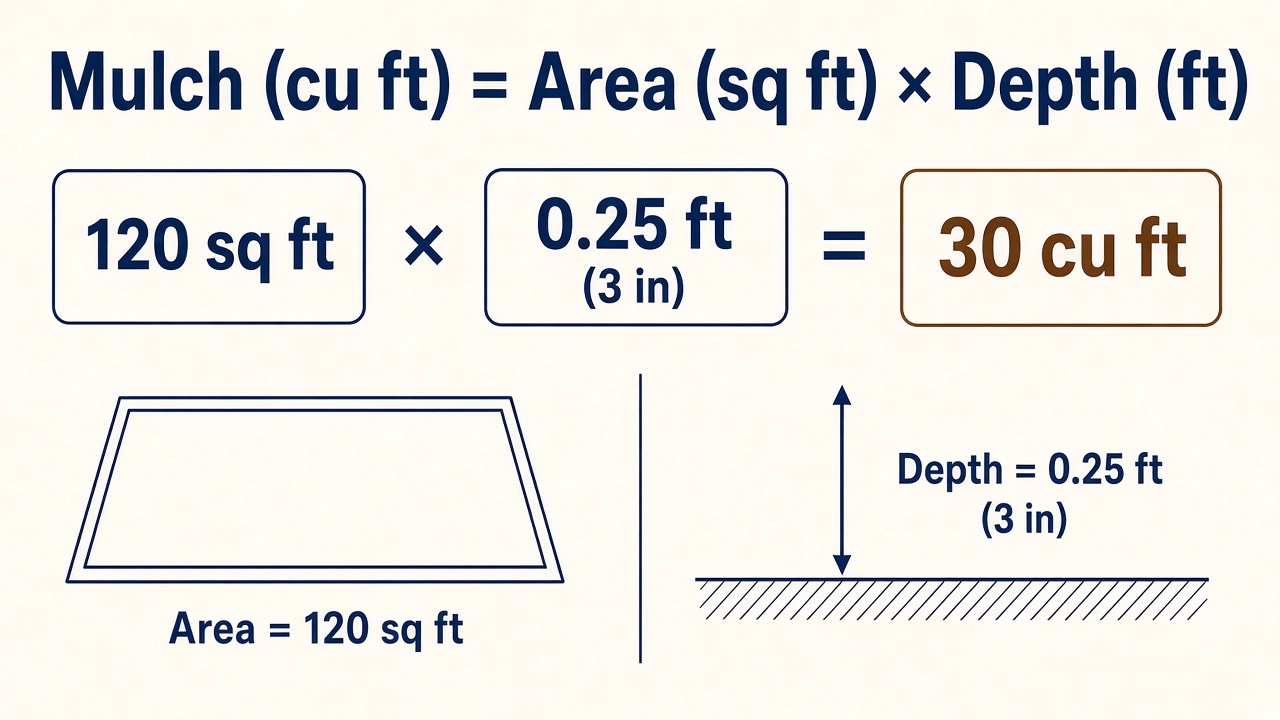
For a bed of 200 square feet at 2 inches deep, the calculation is 200 × 0.167 = 33.4 cubic feet. Keeping the depth in feet is the step people miss, because multiplying an area in square feet by a depth in inches gives a number that is 12 times too large.
How to Calculate Mulch Step by Step
Calculate the mulch you need in 4 steps:
- Measure the bed’s length and width in feet, then multiply for the area in square feet.
- Choose a depth in inches and convert it to feet by dividing by 12.
- Multiply the area by the depth in feet to get the cubic feet of mulch.
- Divide by 27 for cubic yards, or by the bag size for the number of bags.
For an irregular bed, split it into rectangles, find each area, and add them before applying the depth. A curved border is close enough when you use the smallest rectangle that contains the bed, because the small surplus covers spillage and settling.
How to Convert Mulch to Cubic Yards and Bags
Bulk mulch is sold by the cubic yard, and one cubic yard holds 27 cubic feet. Divide your cubic-feet total by 27 to order in yards: a 30-cubic-foot job is 30 ÷ 27 = 1.11 cubic yards, which rounds up to about 1.5 yards to allow for settling. Bulk delivery is the cheaper option for large beds.
Bagged mulch is sold in bags of a fixed size, usually 2 cubic feet. Divide the cubic feet by the bag size and round up: a 30-cubic-foot job needs 30 ÷ 2 = 15 bags. Bagged mulch suits small beds and jobs where a delivery is not practical. For ordering in yards, the cubic feet to cubic yards converter does the division for you.
Worked Example: Mulch for a Front Yard
A front yard has two beds. The first measures 20 feet by 8 feet, and the second measures 15 feet by 6 feet. Both get 3 inches of mulch.
- First bed area: 20 × 8 = 160 square feet.
- Second bed area: 15 × 6 = 90 square feet.
- Total area: 160 + 90 = 250 square feet.
- Apply the depth: 250 × 0.25 = 62.5 cubic feet.
- Convert: 62.5 ÷ 27 = 2.31 cubic yards, or 62.5 ÷ 2 = 32 bags.
The order is about 2.5 cubic yards in bulk, or 32 two-cubic-foot bags. The measurement method here is the same one in the guide on how to calculate cubic feet, applied to a garden bed instead of an appliance.
How Much Area a Cubic Yard Covers
One cubic yard of mulch covers a fixed area that depends only on the depth. At 3 inches deep, a cubic yard covers 27 ÷ 0.25 = 108 square feet. At 2 inches deep, it covers 27 ÷ 0.167 = 162 square feet. A shallower layer stretches the same volume across more ground.
This coverage figure lets you work backward from a delivery. A 3-cubic-yard load spread 3 inches deep covers about 324 square feet, so you can check that an order matches the beds before it arrives. Mulch settles over the first weeks, so ordering a small surplus keeps the finished depth at the target.
Key Takeaways
- Mulch volume equals bed area in square feet times depth in feet: a 120-square-foot bed at 3 inches deep needs 30 cubic feet.
- Convert the depth from inches to feet first (divide by 12), or the result comes out 12 times too large.
- One cubic yard of mulch is 27 cubic feet and covers 108 square feet at 3 inches deep.
- Divide cubic feet by 27 for bulk yards, or by the bag size (usually 2 cubic feet) for bags, and round up.
- Order a small surplus, because mulch settles after it is spread.
Frequently Asked Questions
How much mulch do I need for my garden?
Multiply the bed area in square feet by the mulch depth in feet to get the cubic feet needed. For a 120-square-foot bed at 3 inches (0.25 feet) deep, you need 120 times 0.25, which is 30 cubic feet. Divide by 27 to get cubic yards, or by the bag size to get bags.
How many cubic feet of mulch are in a cubic yard?
One cubic yard of mulch contains 27 cubic feet, because a cubic yard is 3 feet on every side and 3 times 3 times 3 equals 27. Bulk mulch is sold by the cubic yard, so divide your cubic-feet total by 27 to order it in yards.
How many bags of mulch do I need?
Divide the cubic feet of mulch you need by the size of each bag, then round up. Bagged mulch is usually sold in 2-cubic-foot bags, so a 30-cubic-foot job needs 30 divided by 2, which is 15 bags. Always round up, because a store sells whole bags.
How deep should mulch be?
Mulch is usually applied 2 to 3 inches deep for garden beds. Two inches suits annual beds and refreshing existing mulch, and 3 inches suits new beds and weed suppression. Deeper than 4 inches can hold too much moisture against roots, so 2 to 3 inches is the common range.
How much area does a cubic yard of mulch cover?
One cubic yard of mulch covers 108 square feet at 3 inches deep, or 162 square feet at 2 inches deep. Divide 27 cubic feet by the depth in feet to get the coverage: 27 divided by 0.25 is 108 square feet at a 3-inch depth.
Conclusion
The mulch you need comes down to one calculation: bed area in square feet times depth in feet gives the cubic feet, which converts to cubic yards by dividing by 27 or to bags by dividing by the bag size. Measure each bed, pick a depth of 2 to 3 inches, and order a small surplus for settling. Work out your exact volume with the Cubic Feet Calculator.
Ready to run the numbers? Use the Cubic Feet Calculator.