
How to Calculate Cubic Feet of a Refrigerator
By Jane Robert, Content SpecialistReviewed by the Measurement & Standards Team
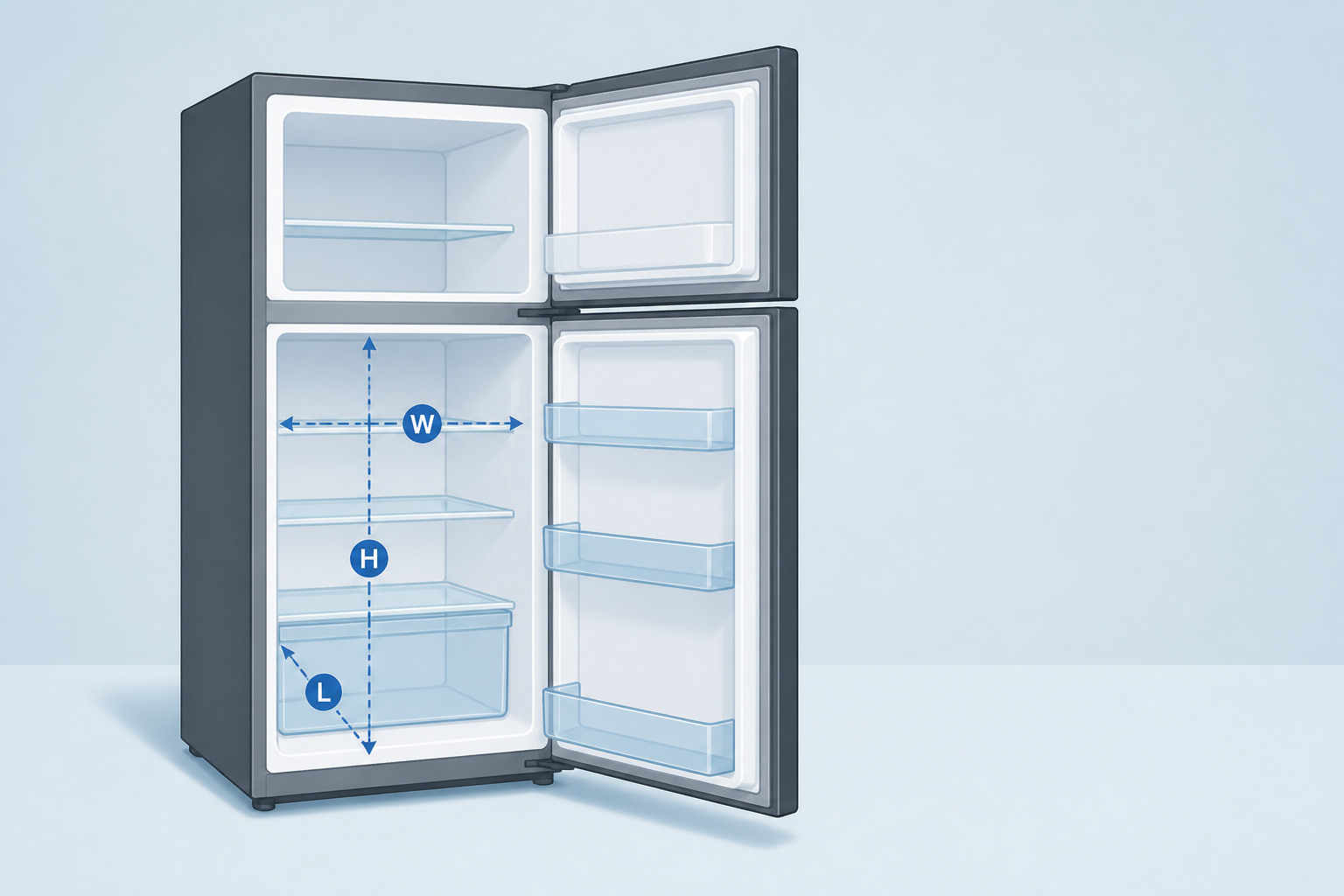
How to Calculate Cubic Feet of a Refrigerator
Calculate the cubic feet of a refrigerator with the Cubic Feet Calculator by multiplying the interior length × width × depth in feet, or by measuring in inches and dividing the product by 1,728. The result is the appliance capacity in cubic feet (ft³), the same number a manufacturer lists on the specification sheet. Capacity describes the interior cavity, so every measurement is taken inside the cabinet with the shelves and drawers removed.
Two rules keep the figure accurate. Measure the storage cavity rather than the exterior shell, because the walls, insulation, and compressor housing add 3 to 5 inches the food never occupies. Convert every dimension to the same unit before multiplying, since mixing inches and feet produces an invalid result.
Refrigerator capacity is one of the first numbers a buyer checks, and it decides whether a household has enough cold storage.
The Cubic Feet Formula for a Refrigerator
The refrigerator cubic feet formula is Cubic Feet = Length (ft) × Width (ft) × Height (ft). All three dimensions describe the interior. A cavity measuring 2.5 ft wide, 2.3 ft deep, and 4.5 ft tall holds 2.5 × 2.3 × 4.5 = 25.88 cubic feet (733 liters).
The formula treats the refrigerator interior as a rectangular box, which matches the shape of the fresh-food and freezer cavities closely enough for a reliable result. A refrigerator with rounded interior corners or molded door bins holds slightly more than the box formula returns, and the difference is covered later under measurement accuracy.
How to Measure a Refrigerator in Inches
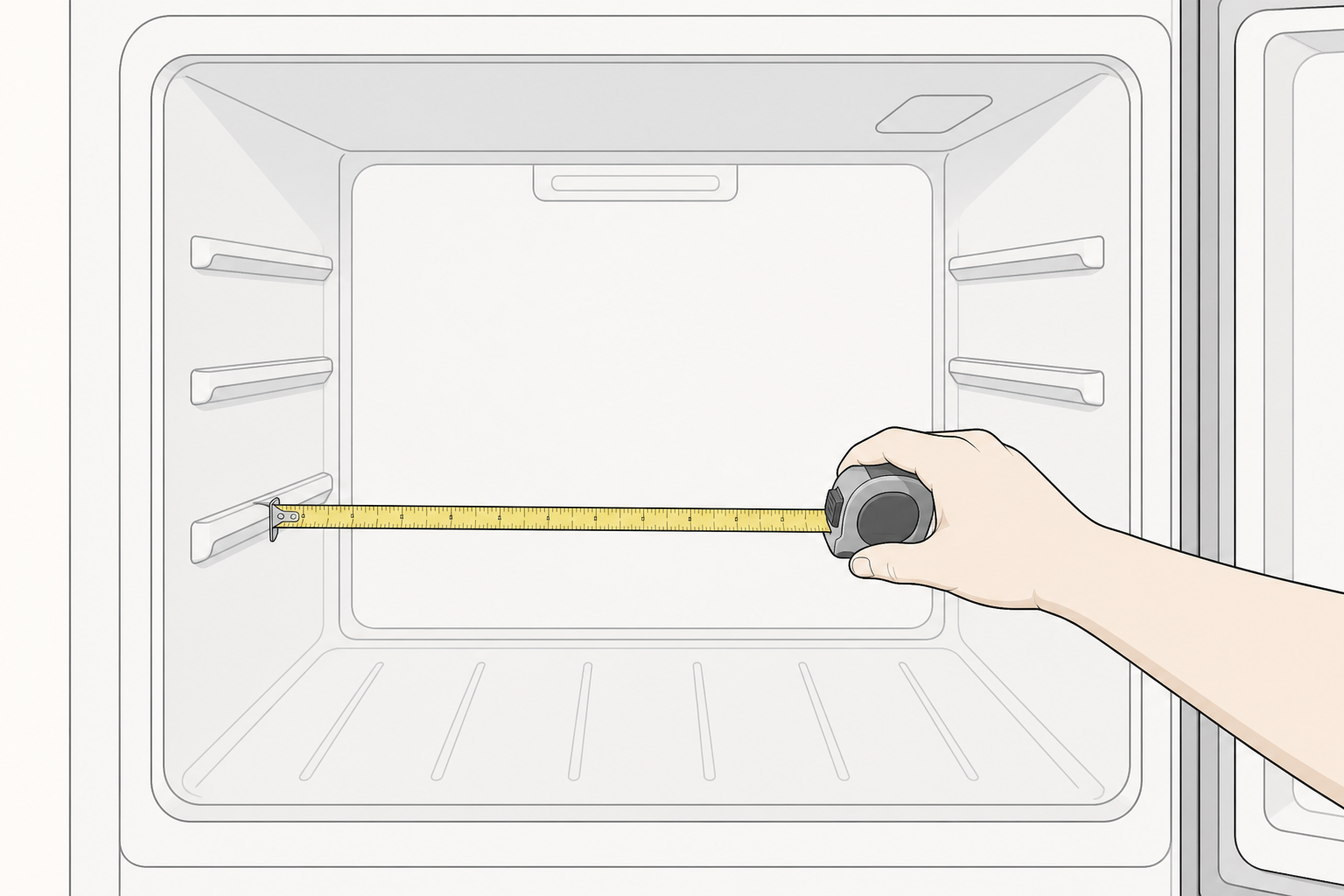
Measure a refrigerator in 5 steps, using a soft tape measure and an empty cabinet:
- Empty the interior and remove every shelf, drawer, and bin, so the tape reaches the cavity walls.
- Measure the interior width across the widest point of the fresh-food cavity, wall to wall.
- Measure the interior depth from the back wall to the inside face of the closed door line.
- Measure the interior height from the cavity floor to the ceiling, skipping the light housing.
- Repeat the three measurements for the freezer cavity, because published capacity combines both compartments.
Record every number in inches. A soft tape measure follows the cavity contour better than a rigid rule, and a second reading of each dimension catches the small errors that shift a capacity result. Measurements taken with the shelves in place understate the cavity, so the empty-cabinet step matters most.
How to Convert Refrigerator Measurements to Cubic Feet
Convert measurements to cubic feet with one operation, chosen by the unit the tape reports. Each conversion below turns a raw dimension product into cubic feet.
- From inches: multiply length × width × height in inches, then divide by 1,728, because one cubic foot contains 1,728 cubic inches (12 × 12 × 12).
- From centimeters: multiply the three centimeter dimensions, then divide by 28,316.8, because one cubic foot contains 28,316.8 cubic centimeters. Convert the result to liters with the Cubic Feet to Liters Converter.
- From meters: multiply the three meter dimensions, then multiply by 35.315, because one cubic meter equals 35.315 cubic feet.
The inch method suits appliances sold in the United States, where interior labels and spec sheets use inches. Converting the inch product once, rather than converting each dimension to feet first, avoids three rounding steps and returns a more accurate figure.
Worked Example: Cubic Feet of a Top-Freezer Refrigerator
A top-freezer refrigerator has a fresh-food cavity measuring 28 in wide, 29 in deep, and 44 in tall. Its freezer cavity measures 28 in wide, 29 in deep, and 16 in tall.
- Fresh-food volume: 28 × 29 × 44 = 35,728 cubic inches. Divide by 1,728 = 20.68 cubic feet.
- Freezer volume: 28 × 29 × 16 = 12,992 cubic inches. Divide by 1,728 = 7.52 cubic feet.
- Total capacity: 20.68 + 7.52 = 28.20 cubic feet (799 liters).
The combined figure of 28.20 cubic feet matches the range printed for a large top-freezer model. A measured result within 1 to 2 cubic feet of the spec sheet confirms the method. The small gap comes from shelf rails and molded contours the raw box formula ignores.
Worked Example: Cubic Feet of a French-Door Refrigerator
A french-door refrigerator has a fresh-food cavity measuring 31 in wide, 27 in deep, and 42 in tall. Its bottom freezer drawer measures 31 in wide, 24 in deep, and 14 in tall.
- Fresh-food volume: 31 × 27 × 42 = 35,154 cubic inches. Divide by 1,728 = 20.34 cubic feet.
- Freezer volume: 31 × 24 × 14 = 10,416 cubic inches. Divide by 1,728 = 6.03 cubic feet.
- Total capacity: 20.34 + 6.03 = 26.37 cubic feet (747 liters).
A french-door model reaches a high capacity through width rather than height, which keeps frequently used shelves at eye level. The wide fresh-food cavity explains why french-door refrigerators dominate the 22 to 28 cubic feet class.
Typical Refrigerator Capacities in Cubic Feet
Refrigerator capacity falls into 4 common classes by cabinet style. The table below lists the interior volume each style typically provides, so a measured result can be matched to a category.
| Refrigerator style | Typical capacity | Metric equivalent |
|---|---|---|
| Compact / mini | 1.7-4.5 cu ft | 48-127 liters |
| Top-freezer | 18-22 cu ft | 510-623 liters |
| Side-by-side | 22-26 cu ft | 623-736 liters |
| French-door | 22-28 cu ft | 623-793 liters |
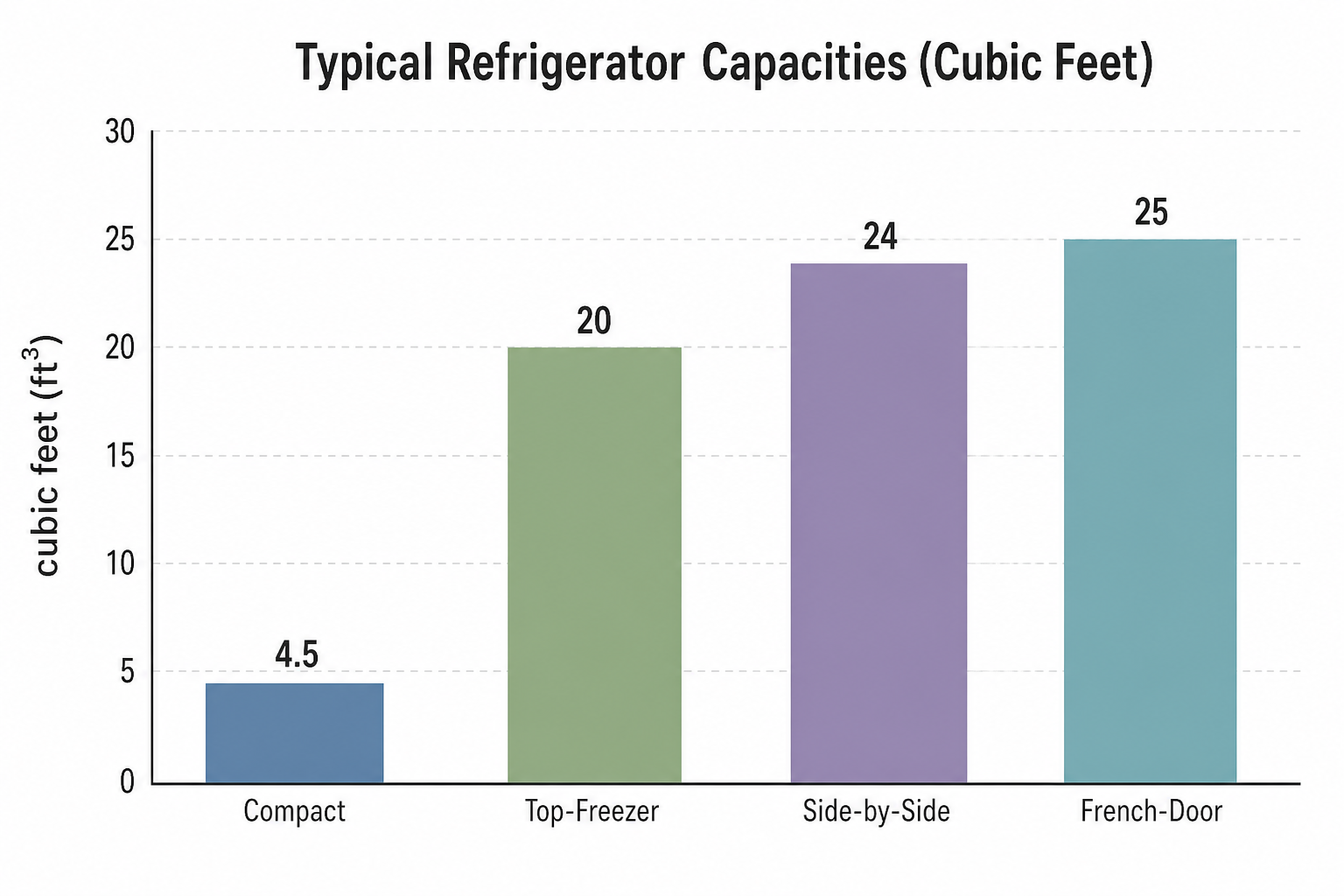
Compact refrigerators suit offices, dorm rooms, and bar areas. Top-freezer models offer the most capacity per dollar. Side-by-side and french-door models trade some usable volume for wider shelves and door-mounted water dispensers. The capacity a household needs scales with the number of residents, covered in the sizing section below; size a room’s air volume with the Room / House Cubic Feet Calculator.
Why Interior Dimensions Define Refrigerator Capacity
Refrigerator capacity is measured on the inside, because capacity describes the space the food occupies. A refrigerator with a 36-inch-wide cabinet holds a cavity 1 to 2 inches narrower on each side, since the walls carry insulation, cooling coils, and the door gasket. Measuring the exterior overstates capacity and mismatches the spec sheet.
Manufacturers measure to the inner door line and include the door bins, which adds usable volume the wall-to-wall method misses. This difference explains why a careful home measurement often lands 1 to 3 cubic feet below the printed rating. The home figure describes the main cavity; the rated figure adds the door storage.
Common Mistakes When Measuring Refrigerator Cubic Feet
Three common mistakes push a refrigerator cubic feet result off by 2 or more cubic feet:
- Measuring the exterior cabinet instead of the interior cavity, which overstates capacity by the wall thickness on every side.
- Leaving shelves and drawers in place, which blocks the tape from reaching the cavity walls and understates depth and height.
- Mixing units within one calculation, such as multiplying a width in inches by a height in feet, which produces a number with no valid unit.
Two less frequent errors also distort the figure. Measuring only the fresh-food cavity omits the freezer, which understates a combined rating by 6 to 8 cubic feet on a full-size model. Rounding each dimension to the nearest inch before multiplying compounds a small error across three measurements, so the raw readings should enter the calculation unrounded.
How Much Refrigerator Capacity Do You Need?
A household needs 4 to 6 cubic feet of refrigerator capacity per adult (113 to 170 liters). One adult needs 4 to 6 cubic feet, and two adults need 8 to 12 cubic feet. A family of four needs 19 to 22 cubic feet (538 to 623 liters) once bulk and frozen storage are added. Households that batch-cook, store large platters, or freeze in volume should add 3 to 5 cubic feet above the baseline.
Capacity should guide the purchase before exterior dimensions, because a cabinet that fits the kitchen opening can still hold too little food. Measure the interior of a candidate model, or read the spec sheet, and match the cubic feet to the household size. A refrigerator sized 2 to 3 cubic feet above the current need absorbs holiday cooking and grocery bulk without forcing a second appliance.
Frequently Asked Questions
How many cubic feet is a standard refrigerator?
A standard full-size refrigerator holds 18 to 26 cubic feet (510 to 736 liters) of interior space. Compact and mini refrigerators hold 1.7 to 4.5 cubic feet (48 to 127 liters). The figure counts the fresh-food and freezer cavities combined.
How do you measure the cubic feet of a fridge without the manual?
Measure the interior width, depth, and height in inches with the shelves removed, multiply the three numbers, and divide by 1,728. The result is the total capacity in cubic feet, the same figure a manufacturer prints on the spec sheet.
Is refrigerator capacity measured on the inside or the outside?
Refrigerator capacity is measured on the inside. Capacity describes the usable storage cavity, so the interior length, width, and depth define the cubic feet, not the exterior cabinet dimensions.
How many cubic feet do I need for a family of four?
A family of four needs 19 to 22 cubic feet (538 to 623 liters) of refrigerator capacity. The common guideline allocates 4 to 6 cubic feet per adult, then adds space for bulk and frozen storage.
Why is my measured cubic feet lower than the manufacturer rating?
A measured result runs 1 to 3 cubic feet below the rating because the box formula ignores door bins and the curved cavity corners the manufacturer counts. Manufacturers measure to the inner door line, which adds usable volume the wall-to-wall method misses.
How many cubic feet is a mini fridge?
A mini fridge holds 1.7 to 4.5 cubic feet (48 to 127 liters). Cube models used in dorm rooms hold 1.7 to 2.7 cubic feet, and taller compact models with a separate freezer hold 3.1 to 4.5 cubic feet.
Does freezer space count in refrigerator cubic feet?
Yes. Published refrigerator capacity combines the fresh-food cavity and the freezer cavity. Measure each compartment separately, then add the two cubic-feet figures for the total the spec sheet reports.
Ready to run the numbers? Use the Refrigerator / Fridge Cubic Feet Calculator.