
What is a cubic foot? Definition, size, and everyday examples
By Jane Robert, Content SpecialistReviewed by the Measurement & Standards Team
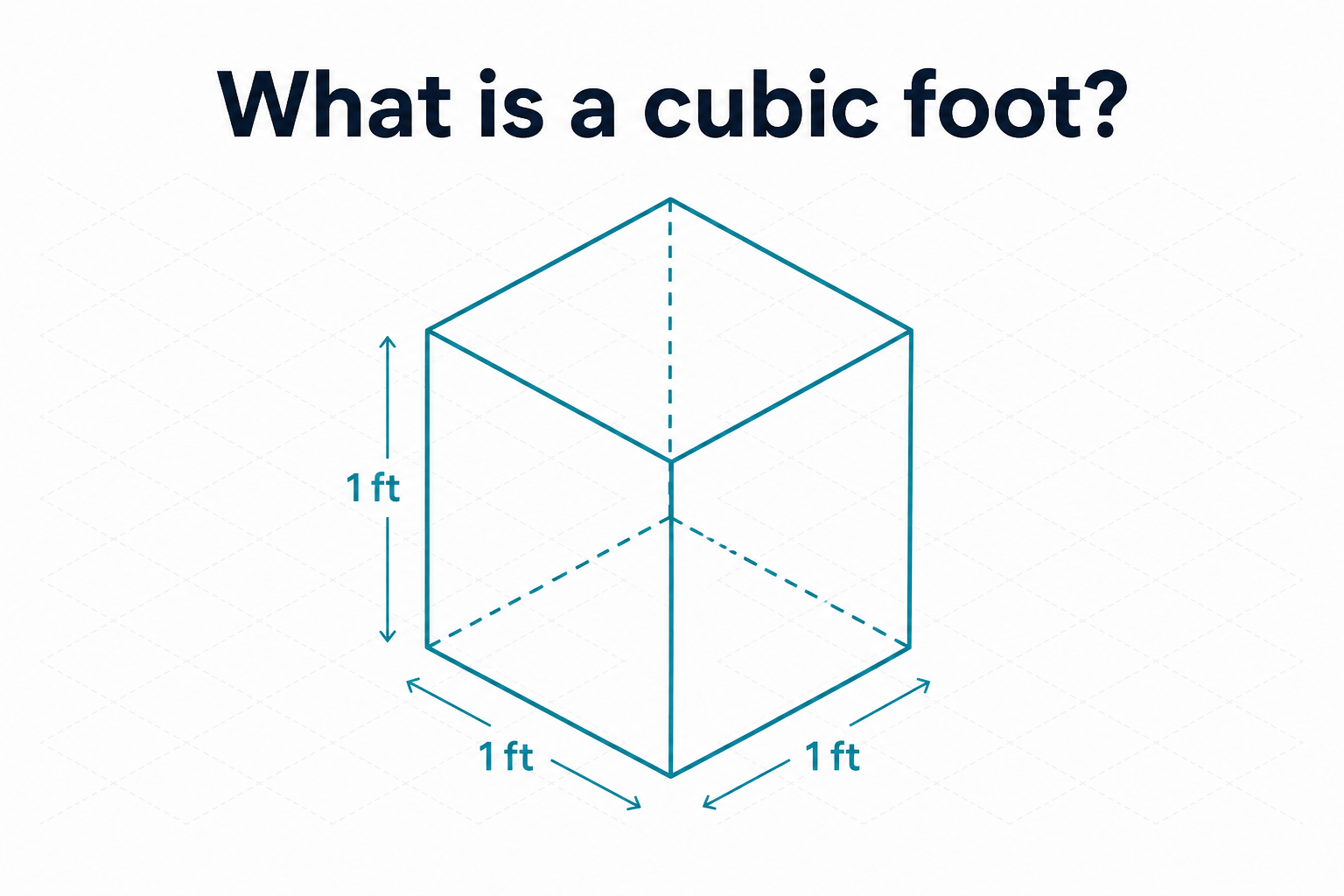
A cubic foot is the volume of a cube measuring one foot on every side. One foot equals 12 inches (30.48 centimeters), so a cubic foot equals 1,728 cubic inches, 28.317 liters, and 7.481 US gallons. The symbol is ft³, and common abbreviations include cu ft and CFT. The cubic foot is a unit of volume in the imperial and US customary systems. The United States and the United Kingdom use it to size appliances, moving loads, freight, storage units, and landscaping materials.
This page defines the cubic foot, shows its size against everyday objects, separates it from square feet, and lists where the unit appears in daily life. To measure a specific space, enter three dimensions in the Cubic Feet Calculator.
What is a cubic foot?
A cubic foot is the volume of a cube one foot on every side. Volume measures three-dimensional space: length, width, and height multiplied together. A cube one foot long, one foot wide, and one foot tall encloses exactly one cubic foot of space.
The foot equals 0.3048 meters by international definition, which fixes the cubic foot at 0.0283 cubic meters. The IEEE standard symbol for the unit is ft³. Written abbreviations include cu ft, cu.ft, cuft, cbft, and CFT, the form common in Indian construction and timber trade.
How big is a cubic foot?
One cubic foot equals 1,728 cubic inches. That figure comes from the definition: 12 inches × 12 inches × 12 inches equals 1,728 cubic inches. The same volume converts to six other units of measure used for shipping, cooking, and construction.
How many cubic inches are in a cubic foot?
One cubic foot contains 1,728 cubic inches. Each edge of the cube measures 12 inches (30.48 centimeters), and 12 × 12 × 12 equals 1,728. To convert cubic inches back to cubic feet, divide the cubic-inch figure by 1,728.
What a cubic foot equals in other units
The table below converts one cubic foot into the volume and capacity units people search for most, in both metric and US customary systems.
| Unit | One cubic foot equals | Converter |
|---|---|---|
| Cubic inches | 1,728 in³ | Cubic Feet to Cubic Inches Converter |
| Cubic yards | 0.037 yd³ | Cubic Feet to Cubic Yards Converter |
| Cubic meters | 0.0283 m³ | Cubic Feet to Cubic Meters Converter |
| Liters | 28.317 L | Cubic Feet to Liters Converter |
| US gallons | 7.481 gal | Cubic Feet to Gallons Converter |
| US quarts | 29.922 qt | Cubic Feet to Quarts Converter |
One cubic yard contains 27 cubic feet, because a cubic yard is a cube three feet on every side and 3 × 3 × 3 equals 27. One cubic meter contains 35.315 cubic feet.
What does a cubic foot look like? Everyday examples
A standard file box holds 1.04 cubic feet, which makes it the closest everyday reference for the unit. The box measures 15 inches long, 12 inches wide, and 10 inches tall (38 × 30 × 25 centimeters), for 1,800 cubic inches, or 1.04 cubic feet. Picturing one file box gives an accurate sense of one cubic foot of space.
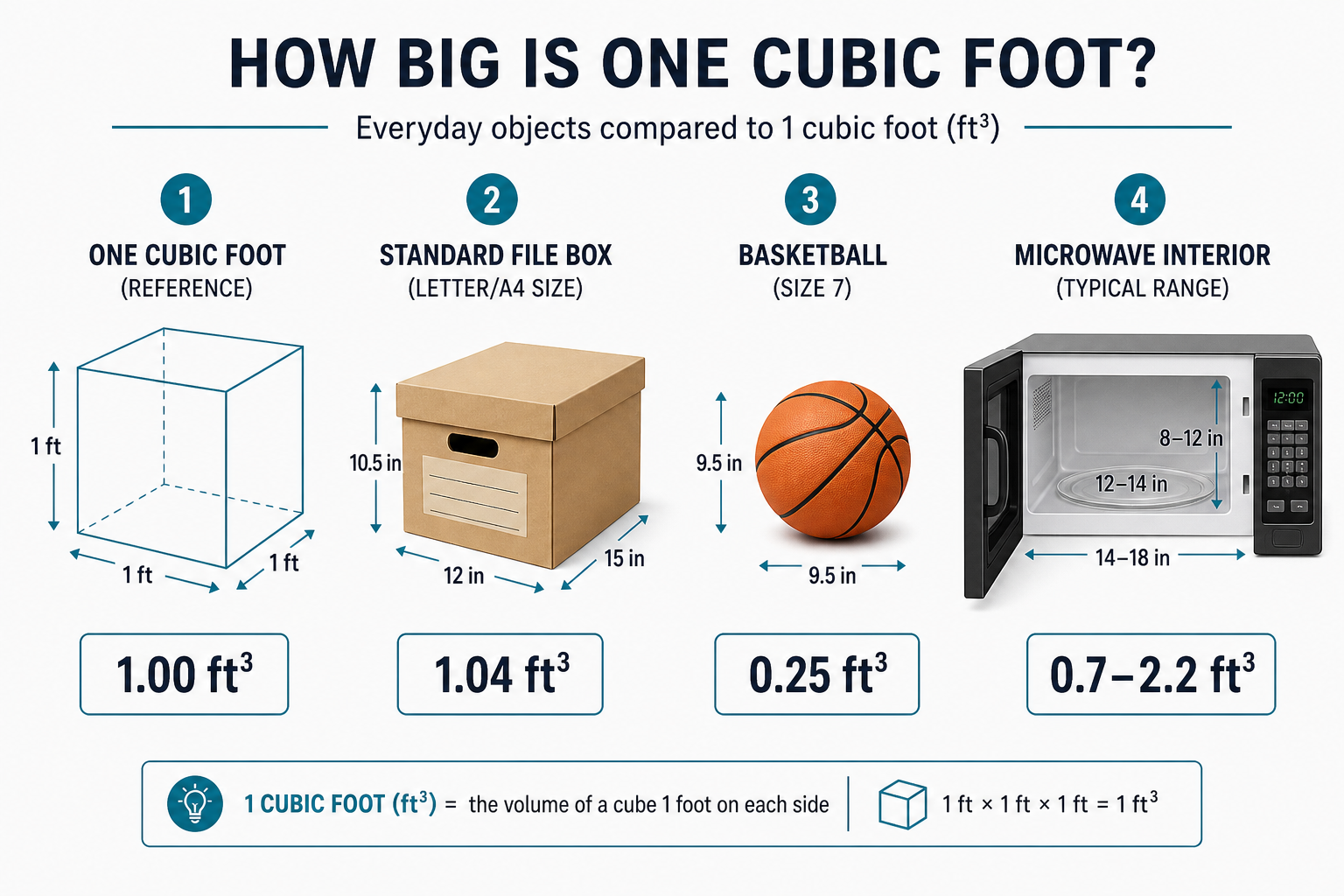
Other common objects give further reference points across a range of sizes:
- Basketball: about 0.25 cubic feet, so four basketballs occupy roughly one cubic foot.
- Microwave interior: 0.7 to 2.2 cubic feet for countertop models.
- Dishwasher interior: about 5 cubic feet of usable space.
- Standard bathtub: 4 to 6 cubic feet of water at a normal fill line.
- Room 10 feet by 10 feet (3 by 3 meters) with an 8-foot (2.4-meter) ceiling: exactly 800 cubic feet of air.
Archivists use the cubic foot to measure collection size. A Federal Records Center carton holds about one cubic foot of documents, so a 200-cubic-foot collection fills roughly 200 such cartons.
Cubic feet vs square feet: what is the difference?
A cubic foot is not the same as a square foot. A square foot measures area across two dimensions: length multiplied by width. A cubic foot measures volume across three dimensions: length multiplied by width multiplied by height. A square foot covers a flat surface such as flooring, while a cubic foot fills a space such as a room of air or a tank of water.
The two units connect only through height. Multiplying an area in square feet by a height in feet produces a volume in cubic feet. Dividing a volume in cubic feet by a height in feet returns the floor area in square feet. An 800-cubic-foot room with an 8-foot ceiling covers 100 square feet, because 800 divided by 8 equals 100. The Cubic Feet to Square Feet Converter performs the division.
How do you calculate a cubic foot?
Calculate a cubic foot by multiplying length × width × height with all three dimensions in feet. A space 5 feet long, 4 feet wide, and 3 feet tall holds 5 × 4 × 3, or 60 cubic feet. Two rules keep the result accurate: measure the space that gets filled rather than the outer shell, and convert every dimension to the same unit before multiplying.
Refrigerator capacity, for example, comes from the interior length, width, and depth, not the outside of the cabinet. The Cubic Feet Calculator multiplies the three dimensions and returns the volume in seven units at once. For a space split into rectangles, such as an L-shaped trunk, the Irregular Shape Cubic Feet Calculator adds the sections automatically.
Calculating from inches, yards, meters, and centimeters
Measurements taken in a unit other than feet convert with one extra step after multiplying the three dimensions:
- Inches: divide the cubic-inch total by 1,728, since one cubic foot contains 1,728 cubic inches.
- Yards: multiply the cubic-yard total by 27, since one cubic yard contains 27 cubic feet.
- Meters: multiply the cubic-meter total by 35.315, since one cubic meter contains 35.315 cubic feet.
- Centimeters: divide the total by 28,316.8, since one cubic foot contains 28,316.8 cubic centimeters.
Where cubic feet are used in everyday life
People measure cubic feet for appliance sizing, moving and storage, gardening, construction, freight shipping, and heating and ventilation. Each context turns a volume figure into a practical decision about capacity, cost, or equipment size.
Appliances: refrigerators, freezers, microwaves, and washers
Appliance capacity is rated in cubic feet of interior space. Full-size refrigerators run 18 to 26 cubic feet (510 to 736 liters), and compact models run 1.7 to 4.5 cubic feet. Microwaves run 0.7 to 2.2 cubic feet, and standard washing-machine drums hold 3.5 to 5 cubic feet. Measure the interior, not the outer cabinet, to compare models accurately. Size the appliance with the Refrigerator / Fridge Cubic Feet Calculator or the Microwave Cubic Feet Calculator. Laundry capacity uses the Washer / Dryer Cubic Feet Calculator.
Moving and storage
Movers quote by load volume, and storage facilities size units in cubic feet. Standard moving boxes come in five sizes:
- Extra small: 1 cubic foot
- Small: 1.5 cubic feet
- Medium: 3 cubic feet
- Large: 4.5 cubic feet
- Extra large: 6 cubic feet
A 5-foot by 10-foot storage unit with an 8-foot ceiling holds 400 cubic feet. Total an inventory with the Moving Cubic Feet Calculator. Match the figure to a unit with the Storage Unit Cubic Feet Calculator.
Gardening and construction
Landscaping and building materials sell by the cubic foot in bags and by the cubic yard in bulk. Bagged mulch holds 2 cubic feet, bagged soil 1.5 cubic feet, and an 80-pound (36-kilogram) bag of concrete mix yields 0.6 cubic feet. Calculate a garden bed with the Mulch Cubic Feet Calculator or the Soil Cubic Feet Calculator. Size a slab pour with the Concrete Cubic Feet Calculator.
Shipping, HVAC, and utilities
Freight carriers price shipments partly on cargo volume in cubic feet, which feeds the density figure behind a freight class. Heating and cooling equipment is sized from a room’s air volume, so a larger cubic-foot figure calls for a higher BTU rating. Natural gas and water utilities bill in hundreds of cubic feet. Size a room’s air volume with the Room / House Cubic Feet Calculator.
Larger cubic-foot units: CCF, MCF, and brass
Commerce and industry group cubic feet into larger units for billing and bulk trade. These units keep the cubic foot as their base while scaling it by hundreds, thousands, or millions.
- CCF or HCF: one hundred cubic feet, used to bill natural gas and household water.
- MCF: one thousand cubic feet, used in the oil and gas industry.
- MMCF: one million cubic feet, used for gas production volumes.
- BCF: one billion cubic feet, used for gas reserves and dam storage.
- Brass: one hundred cubic feet, an Indian unit for sand, aggregate, and timber.
The brass unit appears often in South Asian construction quotes. Convert between the two with the Brass to Cubic Feet Converter.
Cubic feet in airflow: CFM and CFS
Cubic feet also measure flow, meaning the volume of gas or liquid passing a point over time. Cubic feet per minute (CFM) measures air delivery, and applies to carburetors, pneumatic tools, air compressors, and ventilation fans. A room needs a baseline of about 1 CFM of supply air per square foot of floor.
Cubic feet per second (CFS), also called cusec, measures water flow in rivers and canals. One cubic foot per second equals 28.317 liters per second. Flow units describe a rate, while a plain cubic foot describes a fixed quantity of space.
A short history of the cubic foot
The cubic foot derives from the foot, a length unit standardized at 0.3048 meters. The unit belongs to the imperial and US customary systems, which developed from older English units of measure. Most countries adopted the metric cubic meter for volume, while the United States and the United Kingdom kept the cubic foot for appliances, construction, shipping, and utility billing. The cubic foot remains the standard consumer volume unit in both countries today.
Frequently asked questions
What exactly is a cubic foot in simple terms?
A cubic foot is the amount of space inside a cube one foot on every side. One foot equals 12 inches (30.48 centimeters), so the cube measures 12 inches wide, 12 inches deep, and 12 inches tall, enclosing 1,728 cubic inches of space.
How big is one cubic foot compared to everyday objects?
One cubic foot is about the size of a standard file box, which holds 1.04 cubic feet. A basketball occupies about 0.25 cubic feet, and a countertop microwave interior runs 0.7 to 2.2 cubic feet. Four basketballs together fill roughly one cubic foot.
What is the symbol and abbreviation for a cubic foot?
The symbol for the cubic foot is ft³, set by the IEEE standard for units of measurement. Common written abbreviations include cu ft, cu.ft, cuft, and cbft. The form CFT appears widely in Indian construction and timber trade.
What does CFT mean?
CFT means cubic feet, and the abbreviation is used mainly in India and other South Asian countries for construction and timber volume. One CFT equals one cubic foot, or 1,728 cubic inches (28.317 liters).
Why do refrigerators and freezers use cubic feet?
Refrigerators and freezers use cubic feet to state usable interior capacity. The figure comes from the interior length, width, and depth, not the outside cabinet. Full-size refrigerators run 18 to 26 cubic feet (510 to 736 liters), which sets how much food the appliance holds.
Is a cubic foot a unit of volume or weight?
A cubic foot is a unit of volume, not weight. Converting it to pounds needs material density. A cubic foot of water weighs 62.4 pounds (28.3 kilograms), while dry soil weighs 75 to 100 pounds per cubic foot.
Ready to run the numbers? Use the Cubic Feet Calculator.